
Why is Theodent the No. 1 alternative to fluoride?

Theodent represents a breakthrough in oral care. But what exactly makes it a safer and more effective option than fluoride-based toothpastes? Let us simplify the science so that you can make a more informed decision for yourself and your family.

Some of today’s greatest medical technologies were discovered by accident

Penicillin. X-rays. Insulin. Many of our most important medical applications since the late 19th century were not planned goals. They were detours. Before Theodent introduced a new class of luxury toothpaste, it was a detour too. Theodent toothpastes continue a distinguished line of “accidental” discoveries that have catapulted science significantly forward.

The role Theodent has played in overturning traditional views on fluoride cannot be overstated. To understand why, we first need to understand why something as routine as brushing your teeth matters at all.
Oral care is not just about healthy teeth, but about your overall health

From an early age, we are told that brushing our teeth is important. It gives us a clean mouth, nice teeth and fresh breath. Less often, however, do we hear how essential it is for the rest of our body.

Just as it takes in the food we eat and the air we breathe, our mouth is also a gateway for harmful bacteria and infections that can lead to complications in our bones, heart, kidneys and other organs. Dental hygiene is therefore the first line of defence, because problems such as tooth decay and gum disease weaken our ability to fight off intruders at the source.

Simply put, our broader well-being depends to a large extent on a healthy smile.

Our natural defences only help us up to a point

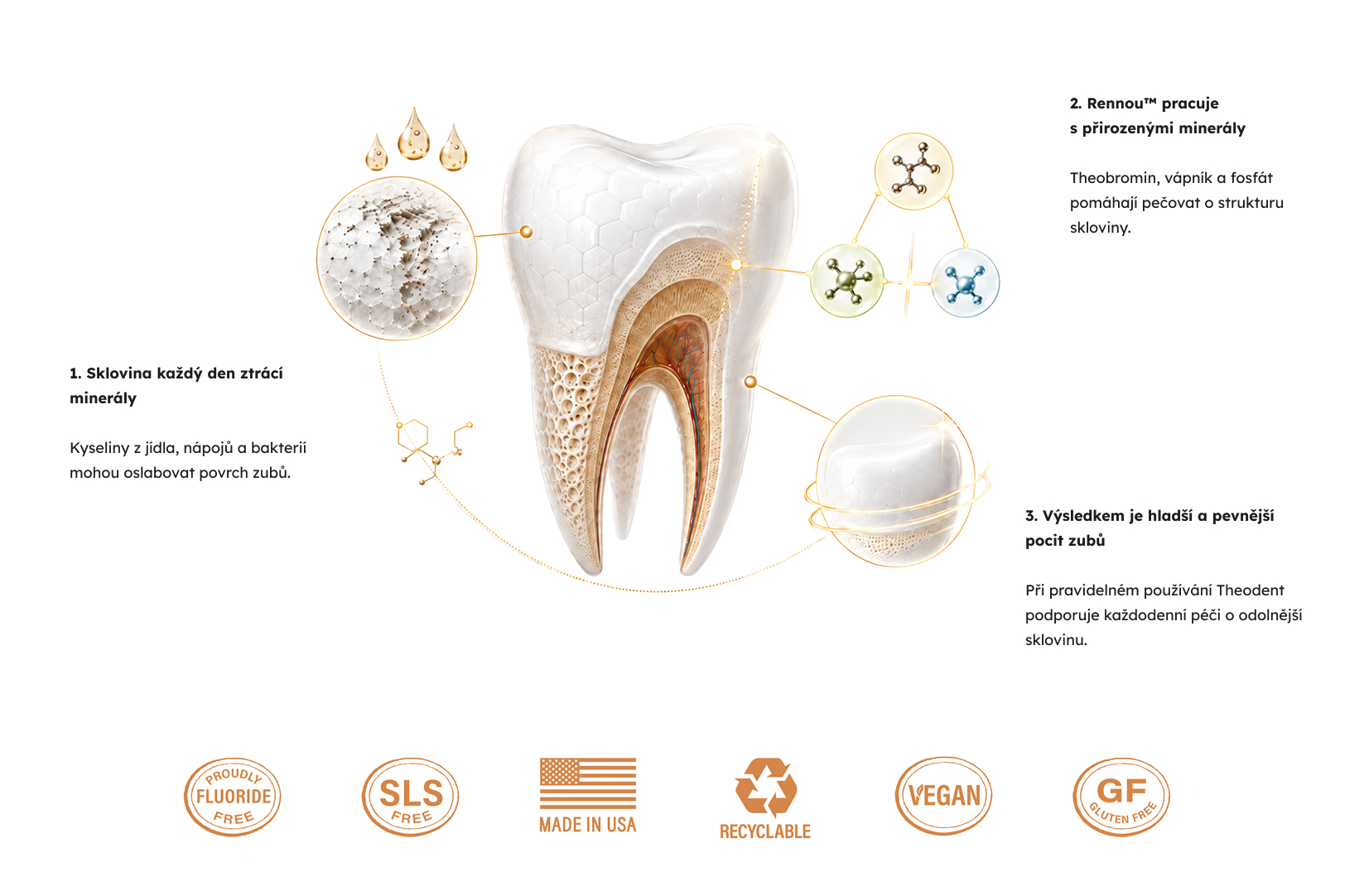
Teeth play an important role in many of our internal systems. This includes housing vital nerves and blood vessels in the mouth. To protect them, our teeth build several layers of protection, starting with the enamel.

Enamel

The hardest tissue in the body. It is made largely of a mineral called hydroxyapatite, which under a microscope looks like a cluster of tiny crystals.

Dentin

The layer beneath the enamel. Although dentin is also a hard tissue, it is porous and contains tiny tubules leading to the nerves in the teeth.

When enamel erodes

The dentin is gradually exposed and the teeth become hypersensitive and painful. Continued exposure of the dentin eventually leads to decay and cavities. Fruit juices, soft drinks, wine and other acidic and sugary products can speed up this process, especially when combined with poor hygiene habits.

Fluoride: a once-popular solution that has lost its appeal

More than 100 years ago, scientists discovered that fluoride helps prevent tooth decay. In the 1950s, fluoride-based toothpastes began to be mass-produced. Since then, these products have been considered the standard and make up the vast majority of toothpaste sales worldwide.

Specifically, studies have shown that fluoride is a neurotoxic substance. Even low levels of ingestion are toxic to the body. The U.S. Food and Drug Administration (FDA) requires fluoride toothpaste to carry a warning that Poison Control should be contacted if more than the recommended amount is swallowed.

Research has linked fluoride to conditions such as:

  • lower IQ in children
  • fluoride-induced calcification or hardening of the pineal gland
  • dental fluorosis (tooth discolouration)
  • thyroid disease
  • skeletal fluorosis (bone disease)

Fluoride is a poison.

When it comes to fluoride and long-term health, there is a catch.

up to 75%

of toothpaste is swallowed by developing children while brushing. Understanding that you have to spit out something that tastes good is confusing for a child.

However important the fight against dental disease is, protecting one aspect of our health cannot come at the expense of others. So why does this part of our daily lives receive relatively little attention, even though it has a major impact on our well-being?

Fortunately, growing awareness of the adverse effects of fluoride has come together with innovative scientific findings and ushered in a new era of oral care.

Cutting-edge tooth protection where no one thought to look

For decades, dental professionals maintained that fluoride was the only chemical capable of preventing tooth decay. That changed in the early 1990s thanks to an accidental discovery that led not only to an alternative, but to one that is completely safe.

Scientists found that a molecule called theobromine enlarges the crystalline structure of the enamel in our teeth. What is more, theobromine – which is readily found in cocoa, among other things – strengthens this structure far better than fluoride. It creates larger and stronger crystals that better protect enamel and dentin, improve remineralisation and eliminate hypersensitivity.

Years of research and development followed. The team isolated theobromine from cocoa, leaving out the harmful fats and sugars found in processed chocolate. They then combined this active ingredient with calcium and phosphate into a patented formula. The launch of “Rennou”, as it was named, marked an unprecedented moment in the history of dental health.

And importantly, it poses no danger to your body if swallowed.

Rennou™: a safer and more effective alternative to fluoride

Rennou became the foundation of a revolutionary new toothpaste: Theodent. Since 2012, Theodent has been the single most effective alternative to fluoride-based toothpastes. It has outperformed leading brands such as Colgate and prescription toothpastes such as Sensodyne Nupro 5000. Theodent also clearly outperforms other fluoride-free options, which merely removed fluoride instead of replacing it.

71×

more fluoride is needed to achieve the same remineralising effect as with Rennou™.

100 %

of exposed dentin tubules are fully or partially protected after just one week of brushing twice a day.

Non-toxic

Theodent is not harmful if swallowed by people of any age and therefore does not need the Poison Control warning required on all fluoride toothpastes.

This means stronger results in less time than fluoride can provide, making Theodent significantly better at strengthening teeth and reducing hypersensitivity. In short, Rennou-based Theodent exceeds the standards for the highest food safety rating of the U.S. Food and Drug Administration (FDA).

Theodent: a refinement in oral care

Dental disease is one of the most common human health problems. It is also one of the most preventable. Thanks to scientific discoveries, we are learning that standard oral treatments – fluoride, for example – are no longer the best choice. Instead, Theodent offers solutions that are safer, deliver better results and meet the demands of a smarter market.

Theodent is now sold worldwide to discerning consumers who seek sophisticated products that support their overall health.

  1. Amaechi, B.T., Mathews, S.M. and Mensinkai, P.K., 2015. Effect of theobromine-containing toothpaste on dentin tubule occlusion in situ. Clinical oral investigations, 19(1), pp.109-116.
  2. Amaechi, B.T., Porteous, N., Ramalingam, K., Mensinkai, P.K., Vasquez, R.C., and Nakamoto, T., 2013. Remineralization of artificial enamel lesions by theobromine. Caries Research, 47(5), pp.399-405.
  3. Chandak, S., Madhu, P.P., Chhabra, K.G., Reche, A., Mahure, G., Giri, S. and Chandak, M., Review on Theobromine: An Alternative to Fluorides in Treating Dentinal Hypersensitivity.
  4. Durhan, M.A., Bilsel, S.O., Gokkaya, B., Yildiz, P.K. and Kargul, B., 2021. Caries Preventive Effects of Theobromine Containing Toothpaste on Early Childhood Caries: Preliminary Results. Acta Stomatologica Croatica, 55(1).
  5. Elsherbini, M.S., 2020. Assessment of remineralization potential of Theobromine and Sodium Fluoride gels on Artificial Caries like lesions. Brazilian Dental Science, 23(3), pp.11-p.
  6. Golfeshan, F., Mosaddad, S.A. and Ghaderi, F., 2021. The Effect of Toothpastes Containing Natural Ingredients Such As Theobromine and Caffeine on Enamel Microhardness: An In Vitro Study. Evidence-Based Complementary and Alternative Medicine, 2021.
  7. Green, R., Lanphear, B., Hornung, R., Flora, D., Martinez-Mier, E.A., Neufeld, R., Ayotte, P., Muckle, G. and Till, C., 2019. Association between maternal fluoride exposure during pregnancy and IQ scores in offspring in Canada. JAMA pediatrics, 173(10), pp.940-948.
  8. Gündoğar, Z.U., Keskin, G. and Çinar, Ç., 2019. Comparison of fluoride and the novel anti-caries agent theobromine on initial enamel caries: an in vitro study. Fluoride, 52(3).
  9. Herisa, H.M., Noerdin, A. and Eriwati, Y.K., 2017, August. The effect of theobromine 200 mg/l topical gel exposure duration against surface enamel hardness resistance from 1% citric acid. In Journal of Physics: Conference Series (Vol. 884, No. 1, p. 012009). IOP Publishing.
  10. Hussein, S.I. and El-Haddad, K.E.S., 2018. Comparison between solution and gel forms of theobromine and sodium fluoride in remineralization of the demineralized human enamel (SEM and EDXA study). Egyptian Dental Journal, 64(3-July (Oral Medicine, X-Ray, Oral Biology & Oral Pathology)), pp.2371-2380.
  11. Irawan, M.I.P., Noerdin, A. and Eriwati, Y.K., 2017, August. The effect of time in the exposure of theobromine gel to enamel and surface hardness after demineralization with 1% citric acid. In Journal of Physics: Conference Series (Vol. 884, No. 1, p. 012005). IOP Publishing.
  12. Kargul, B., Özcan, M., Peker, S., Nakamoto, T., Simmons, W.B. and Falster, A.U., 2012. Evaluation of human enamel surfaces treated with theobromine: a pilot study. Oral Health and Preventive Dentistry, 10(3), p.275.
  13. Lakshmi, A., Vishnurekha, C. and Baghkomeh, P.N., 2019. Effect of theobromine in antimicrobial activity: An in vitro study. Dental research journal, 16(2), p.76.
  14. Nakamoto, T., Falster, A.U. and Simmons Jr, W.B., 2016. Theobromine: a safe and effective alternative for fluoride in dentifrices. Journal of caffeine research, 6(1), pp.1-9.
  15. Nakamoto, T., Falster, A.U. and Simmons Jr, W.B., 2022. The Contrasting Effects between Caffeine and Theobromine on Crystallization: How the Non-fluoride Dentifrice Was Developed. Oral Health Care: An Important Issue of the Modern Society, p.317.
  16. Shawky, R. and Khattab, N., 2021. Evaluation of the remineralizing effect of theobromine and fluoride using scanning electron microscope. Egyptian Dental Journal, 67(1-January (Orthodontics, Pediatric & Preventive Dentistry)), pp.119-126.
  17. Shimizu, S., Kusakabe, S., Toyama, M., Takagaki, T., Kitada, N., Yamamoto, K., Ikeda, M., Ichimura, Y., Burrow, M.F., Hotta, M. and Nikaido, T., 2023. Bacterial adhesion and antibacterial property of coating materials containing theobromine and S-PRG filler. Dental Materials Journal, pp.2021-307.
  18. Suryana, M., Irawan, B. and Soufyan, A., 2018, August. The effects of toothpastes containing theobromine and hydroxyapatite on enamel microhardness after immersion in carbonated drink. In Journal of Physics: Conference Series (Vol. 1073, No. 3, p. 032010). IOP Publishing.
  19. Syafira, G., Permatasari, R. and Wardani, N., 2012. Theobromine effects on enamel surface microhardness: in vitro. J Dent Indonesia, 19(2), pp.32-6.
  20. Taneja, V., Nekkanti, S., Gupta, K. and Hassija, J., 2019. Remineralization potential of theobromine on artificial carious lesions. Journal of International Society of Preventive & Community Dentistry, 9(6), p.576.
  21. Thomas, N.A., Shetty, P., Thimmaiah, C., Shetty, S.B., Sabu, N. and Kripalani, K.B., 2021. Comparative evaluation of the remineralization potential of Theobromine and Fluoride containing dentifrices using Scanning Electron Microscopy with Energy Dispersive X-Ray Analysis: An in-vitro Study. Journal of International Dental and Medical Research, 14(4), pp.1314-1320.
  22. Wulandari, N.Y., Irawan, B. and Herda, E., 2018, August. Effects of theobromine toothpaste on prevention of enamel discoloration from coffee. In Journal of Physics: Conference Series (Vol. 1073, No. 3, p. 032009). IOP Publishing.
  23. Yuanita, T., Setyabudi, S. and Adjani, Q.S., 2019. The effect of theobromine and NaF 2% exposure to enamel surface hardness after immersing in orange juice beverage. Conservative Dentistry Journal, 9(2), pp.70-73.